
Heat Transfer and Fluid Modeling Software
SINDA/FLUINT is a comprehensive finite-difference, lumped parameter (circuit or network analogy) tool for heat transfer design and fluid flow analysis of complex systems. It is used at over 700 sites in 40 countries in the aerospace, electronics, petrochemical, power generation, medical, and automotive industries.
Time-tested Thermal and Fluid Software Tool
For decades, SINDA/FLUINT has provided users with proven and powerful heat transfer and fluids analysis capabilities that continue to expand each year. SINDA/FLUINT is a comprehensive, generalized tool for simulating complex thermal/fluid systems such as those found in the electronics, automotive, petrochemical, power generation, medical, and aerospace industries. SINDA/FLUINT saves time and money by making the design process faster and easier, letting you gain a better understanding of your complex system. You control what is important and how to get the answer to your design performance questions using the most efficient approach. Furthermore, the application is completely extensible making it perhaps the most versatile thermal and fluids software product on the market. You choose the features you want, decide what levels of accuracy and approximation are appropriate, and what outputs are needed. You can even add your own customizations as needed to handle your unique design task, to automate repetitive tasks, or to create user-defined modeling components and correlation libraries.
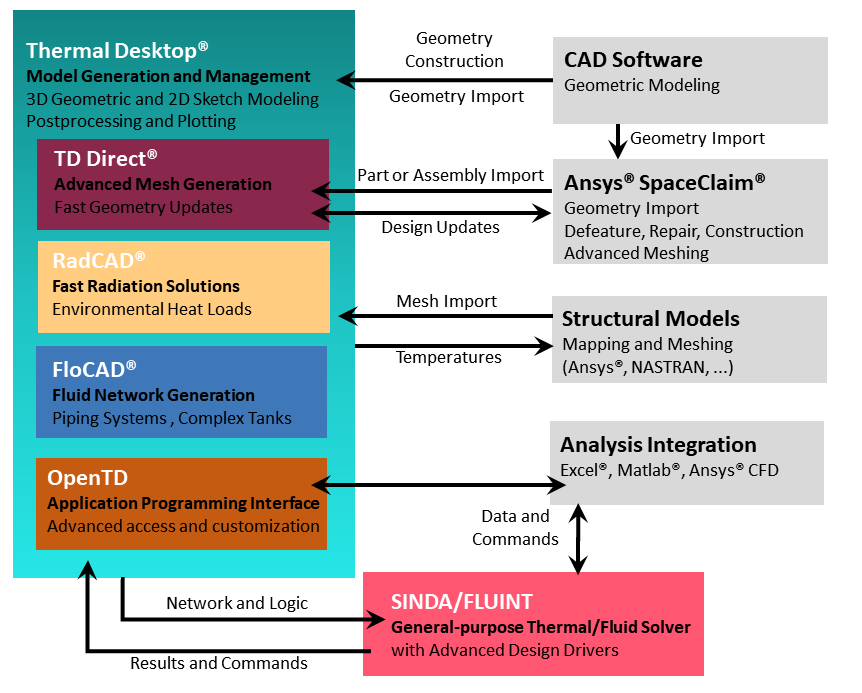
As you can see in the above diagram, SINDA/FLUINT is the solution engine behind Thermal Desktop® and its various modules. Alternatively, SINDA/FLUINT can be used in a text-based mode applying the COM-based API interface with Mathworks' MATLAB® or other COM-aware applications. More often, however, those APIs are used to communicate with Thermal Desktop directly.
Please see the following pages for more in depth topic information
- Two-Phase Flow Capabilities
- Introduction to the Advanced Design Module
 General Features
- Thermal radiation, conduction, convection heat transfer
- From component design to full system performance simulation
- Steady state and transient heat transfer and fluid flow
- Submodels for improved organization, ease of model merge
- Time, temperature, and pressure-varying thermal and fluid properties
- Optional concurrently executed user logic and simulations
- User-determined solution techniques, solution sequences, accuracy levels, and outputs
- Example: iterative vs. sparse matrix inversion
- Methods, controls, etc. can vary submodel by submodel
- Convenient restarts and parametric analysis options
- Compatible with the EZXY® Plotting Utility
- Self-resolving spreadsheet-like expressions and user variables (registers)
- Facilitates model maintenance: centralized changes
- Makes what-if, parametrics, and sensitivity studies trivially easy
- Lets inputs be defined on the basis of outputs, problem time, etc.
- Eliminates the most common uses of user logic
- Extensive library of user-invoked routines (thermostatic heaters, phase change materials, math utilities, etc.)
- Multiple fluid flow networks with coupled heat transfer solutions
- Graphical User Interfaces available, Thermal Desktop® and FloCAD®
- User called routines for modeling common devices and phenomena
- Heat pipes, constant and variable conductance
- Thermoelectric cooling devices
- Ice or frost accretion/melting simulation
 Comprehensive Fluid Flow Analysis
- User-definable fluid properties
- Thermodynamically compressible and incompressible fluids
- Fluids with molecular weight that varies as a function of pressure and temperature
- General pump, valve, duct models
- Single and two-phase flow
- Boiling and condensation
- Homogeneous or slip flow
- Built-in regime mapping
- Flat-front modeling for priming and purging
- Pure fluid substances, or mixtures of gases, liquids, or both
- Condensable/volatile mixtures (psychrometrics, etc.)
- Dissolution/evolution of noncondensible gases
- Equilibrium or finite rate chemical reactions
- Nonequilibrium two-phase volumes
- Turbomachinery: turbines, variable and postitive displacement compressors
- Choking detection and modeling
- Waterhammer and acoustics
- Time- and direction-varying body forces; natural convection
- Simplifying assumptions and exploitation of symmetry
- Wicks and other capillary devices
- Subdivision of control volumes (e.g., stratification)
- Geometry associated with complex compartments and ports
- Kinetic energy transport included for high speed flow phenomena
- Includes spatial accelerations for duct modeling
- Wye/Tee simulations routines for manifold modeling
- Simplified and detailed heat exchanger modeling
Advanced Design Module
- High-level decision support - Advanced Design
- Goal seeking: find design inputs as a function of the desired model response
- Optimization of multiple design variables using arbitrarily complicated constraints
- Automated model correlation to test data
- Reliability engineering to quantify the design reliability
- Synthesize a design that meets reliability requirements up front, intelligently balancing cost against risk
A Brief History of SINDA/FLUINT
 SINDA/FLUINT is the culmination of thermal/fluids software development dating back to the 1960's when the CINDA code was developed by Chrysler Aerospace. TRW revised the code for NASA in 1972 and renamed it to SINDA, a precursor to several subsequent codes including Hughes' CINDA (or HSCINDA), MITAS, and SINDA/G.
In 1982 the NASA/TRW version and MITAS versions were used as starting points for SINDA/FLUINT (then called SINDA '85 or SINDA-85, corresponding to its first release date). In 1986 the fluid module, FLUINT, was first released, greatly expanding the code and making it one of the first co-solved heat transfer and fluids analysis software products. SINDA/FLUINT was well received and has successfully supplanted other SINDA versions and SINDA-like codes, becoming a best-seller and a NASA Space Act Award winner (1991) in the process. NASA continued to guide the development of SINDA/FLUINT until 1992 when the code was identified for commercialization by CRTech. Subsequent improvements over older SINDA codes include submodels, registers and expressions (an underlying spreadsheet), design optimization and test data correlation, statistical design methods, and a comprehensive fluid flow analysis capability.
Originally intended to satisfy the ever-changing modeling needs of the spacecraft and launch vehicle thermal community, SINDA/FLUINT has diffused into other industries such as aircraft, electronic packaging, HVAC, automotive, medical, petrochemical, energy and into other specialties and subsystems such as cryogenic and environmental control. SINDA/FLUINT is intended primarily for designing and analyzing thermal and fluid systems represented in electrical analog, lumped parameter form. Given properly prepared inputs, SINDA can also solve both finite difference and finite element equations: it is better classified as an "equation solver" than its traditional classification as a "finite difference solver."
SINDA/FLUINT is now arguably the most advanced one dimensional thermal/fluids software available in today's market, solving arbitrary fluid flow networks without presuming the application. The networks may contain single-phase vapor or liquid as the working fluid, or combinations of liquid and/or vapor at various locations in the network, and even mixtures of reacting or non-reacting working fluids. These networks are solved in conjunction with one or more accompanying thermal networks, accounting for the energy flows in and out of the fluid system(s).
The improvements that yield the most analytic power, however, are hidden ... or at least external to SINDA/FLUINT. Until the 1990's, SINDA/FLUINT was primarily used as a batch style code run with manually-generated text input files, although archaic codes such as TRASYS were often used to prepare certain inputs such as radiation factors. Now, thanks to a new generation of graphical interfaces, SINDA/FLUINT is primarily used as a "solution engine." These interfaces include the geometry-based Thermal Desktop® (for SINDA conduction/capacitance calculations) with its companion modules RadCAD® (SINDA radiation calculations) and FloCAD® (FLUINT circuits and convective heat transfer calculations).
The integration with FloCAD, which offers both geometric and non-geometric schematic-style modeling, has significantly improved the ease of use for fluid modeling. These unique hybrid 1D+3D features in FloCAD enabled the deprecation of older but popular sketchpad-only interfaces called Sinaps® and SinapsPlus®. The final version of Sinaps featured an automatic model converter into Thermal Desktop and FloCAD format.